A community-led project for cleaner, safer coastal waters
Overview
The 365 Days of Water Testing project is a year-long citizen science initiative led by Final Straw Foundation and Hayling Sewage Watch, running from July 2025 to July 2026 across Emsworth Harbour and Beachlands, Hayling Island.
Our aim is simple: to collect a long-term daily data set of water quality metrics for the two sites, to give the community water quality results that protect public health, build trust, and inform local decision-making.
Objectives
Through this pioneering programme, we aim to:
- Monitor in real time: Conduct daily testing for E.coli, total coliforms, and other pollution indicators using validated Fluidion technology.
- Track wider pollution sources: Measure caffeine, paracetamol, phosphate, and nitrate levels to link trends with sewage discharges and nutrient loading.
- Enhance public safety: Publish results on social media and web so residents, visitors, and water users can make informed choices.
- Support authorities: Provide complementary data to the Environment Agency (EA) and Havant Borough Council as early warnings of pollution events.
- Engage the community: Train more than 20 volunteers, involve schools, and share findings openly.
- Build an evidence base: Identify long-term pollution patterns and hotspots to support better policies and infrastructure investment.
Expected Outcomes
- Transparent updates that strengthen community trust.
- Reduced health risks for swimmers, paddlers, and beachgoers.
- Councils and agencies equipped with additional, actionable data.
- A positive national example of citizen science driving environmental protection.
- Greater understanding of sewage-related pollutants and nutrient impacts.
- Support for local tourism and the economy through a clear commitment to clean water.
How It Works
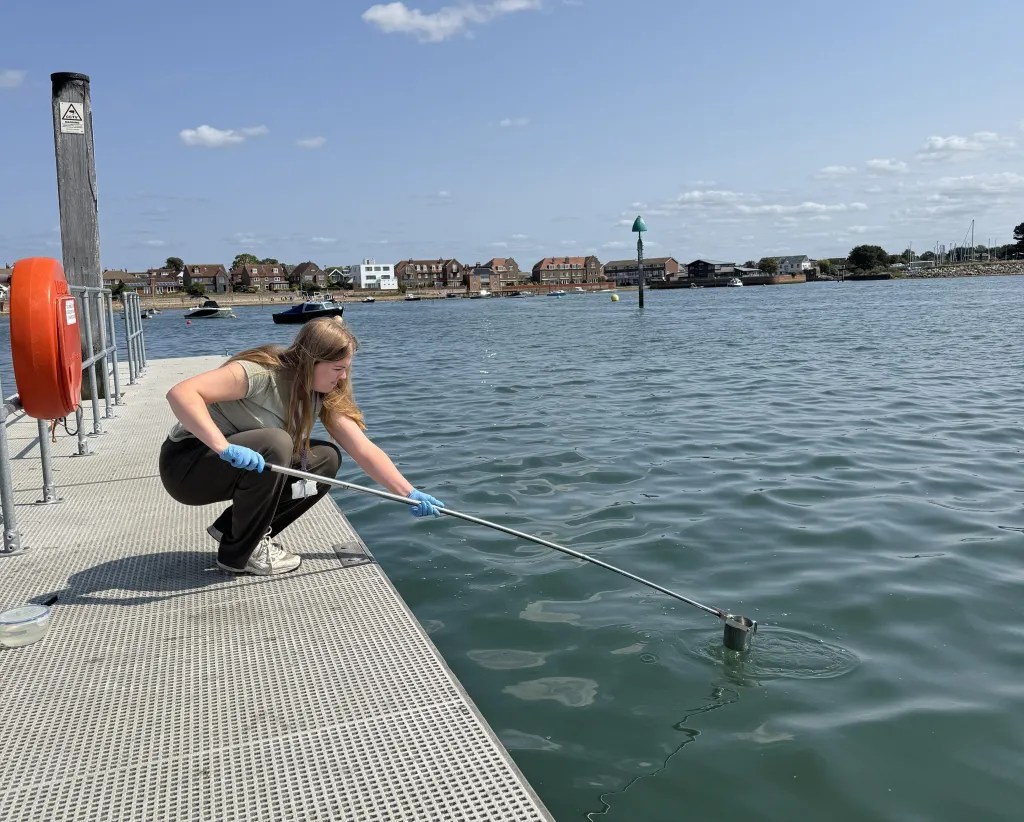
Each day, volunteers collect water samples across two local sites. Using Fluidion testing devices – the same technology used during the 2024 Paris Olympics – they analyse for:
- E.coli: A key indicator of health risk.
- Total coliforms: Broader microbial contamination.
Supplementary testing includes:
- Caffeine & Paracetamol: Reliable tracers of human sewage contamination.
- Phosphate & Nitrate: Nutrients linked to sewage and agricultural runoff, which can trigger algal blooms.
If repeated high E.coli levels are found, samples are sent to Envirochem Laboratories for independent verification. All data are shared publicly via our website and social media, and high readings (over 500cfu/100ml) are reported to the Environment Agency and Havant Borough Council.
Communication & Engagement
Transparency and participation are at the heart of the project.
- Regular Updates: Website & social media.
- Public Access: Open data dashboard – view our data and more information here.
- Media Outreach: Local and national press to highlight citizen science innovation.
Monitoring & Evaluation
We’ll track our success through:
- Outputs: Number of samples, volunteers trained, updates shared.
- Outcomes: Increased awareness and improved data access.
- Impact: New insights into sewage tracers, nutrient pollution, and local water quality.
Evaluation methods will include volunteer feedback, public surveys, data analysis, and policy impact assessment.