By Hannah Cooper, Final Straw Foundation Intern
The dangers of microplastics to the marine environment are no stranger to us. From choking and starving marine life, to becoming entangled in habitats and creatures themselves. But could a new-found threat from microplastics pose a wider concern to both lives on land and at sea?
A new study published in the journal ‘Marine Environmental Research’ * shows that microplastics could be harbouring and transporting dangerous colonies of Vibrio spp. in our oceans. This genus of bacteria can cause skin and wound infections as well as gastroenterological infections such as cholera. The study collected water samples from the North and Baltic Seas and found that the bacteria that causes gastroenteritis, Vibrio parahaemolyticus, was found on 12 different microplastics.

And it’s not only this pathogen that has been proven to colonise microplastics. Researchers at the University of California Davis have been the first to link land-based pathogens with microplastics in our oceans. They have found that a parasite that comes from cat faeces, T.gondii, can survive on microplastic beads and fibres. It is worth mentioning that they found more pathogens on the fibres compared to the beads and these types of fibres (that come from mainly clothing and fishing nets) have already been found in shellfish! The presence of this parasite is extremely worrying as it has been linked to deaths in sea otter populations**, as well as killing other endangered marine wildlife such as Hector’s Dolphins and Hawaiian Monk Seals.
The threat of these findings is monumental, as microplastics are absolutely everywhere from Hayling Island to uninhabited beaches, to the top of the Alps. They can travel far and wide and, in turn, so can the pathogens that survive on them. Microplastics are making it easier for pathogens and diseases to reach sea life. If it doesn’t float away far from the land it came from and infect wildlife there, microplastics sink to the seabed where animals such as oysters, mussels, and other shellfish feed. This poses the risk of these pathogens making their way into the human food chain.
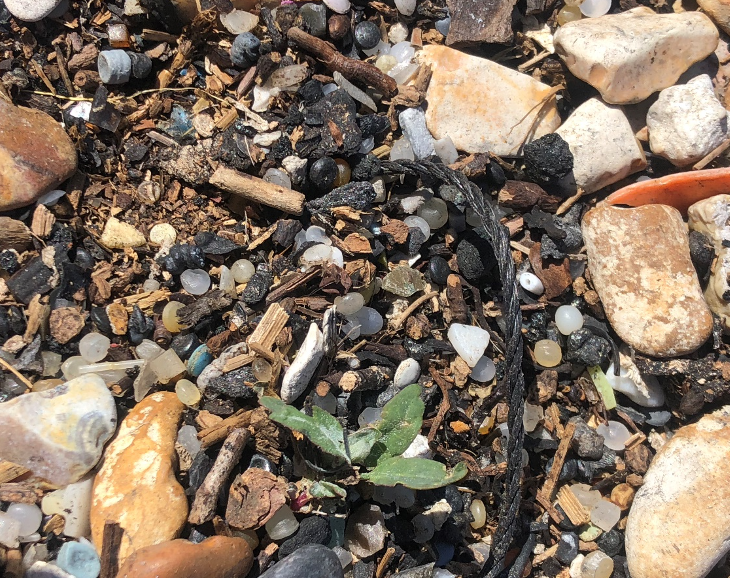
This early research shows that the plastic problem may be even bigger than once thought, and in a post-covid era, the spread of disease seems especially threatening. As always, we urge you to try and reduce the amount of single-use plastic you use, and maybe join us for a beach clean – you can find out when the next one will be here.
Sources:
* Vibrio spp. Study : https://www.sciencedirect.com/science/article/abs/pii/S014111361630112X
** Sea otter Study: https://royalsocietypublishing.org/doi/10.1098/rspb.2019.1334
Podcast
Listen to this blog as a podcast here!