We are really excited that in the last few days we have taken delivery of two large Ridan composters! While we have always had a keen interest in plastic pollution in particular, as an organisation we are actually interested in reducing waste in general. All waste.
Don’t waste electricity, don’t waste paper, don’t waste food. Live the way you want to live but just don’t waste. Look after the natural world, and the animals in it, and the plants in it too. This is their planet as well as ours. Don’t waste them.
It’s a disappointing fact, but generally we are not very good at disposing of food waste in a way that actually uses it to help our soil and environment. At the moment, around 11 million tonnes of food waste goes to landfill every year creating 20% of the UK’s CO2 emissions. This is for all sorts of reasons: perhaps because we live somewhere where there is no infrastructure to deal with composting food waste, possibly because we don’t have an outdoor space to compost our waste, or perhaps because we just don’t know how.
It might not seem obvious, but composting is actually a way to help ocean health. It’s a triple whammy:
- Food is otherwise put inside a plastic bin bag, where it either goes to landfill and slowly produces methane as it breaks down or is burnt for energy, creating more greenhouse gases. A lot of the heat produced from increasing greenhouse gases is absorbed by the ocean, increasing ocean temperatures which in turn risks damaging sensitive and precious marine ecosystems.
- Composting locally reduces the amount of CO2 emissions that would otherwise be created while transporting all this waste to the landfill or energy reclamation facility.
- The compost created can be used to enrich soil, instead of artificial chemical fertilisers. On the south coast of England, as well as everywhere around the world, chemical runoff from land is a huge issue for coastal seas and wider oceans, creating algal blooms that are not good for marine wildlife and ecosystems. Using natural compost helps to avoid the use of these chemicals.
All food waste including meat together with any other bio-degradable vegetation can be added to the mix in these new composters. The end result is a healthy compost that can be used to feed plants and vegetables. You can find out how the composters work here – they do not need electricity. https://www.ridan.co.uk/our-composters/how-the-ridan-composter-works/
We are really looking forward to getting stuck in with the new composters. One of them has been installed at Havant Rugby Club, where it will be used to compost all the food waste from the club. We will be recording the amount of food waste that is diverted from the usual waste streams. The compost created will be used locally and will be available to the local community.
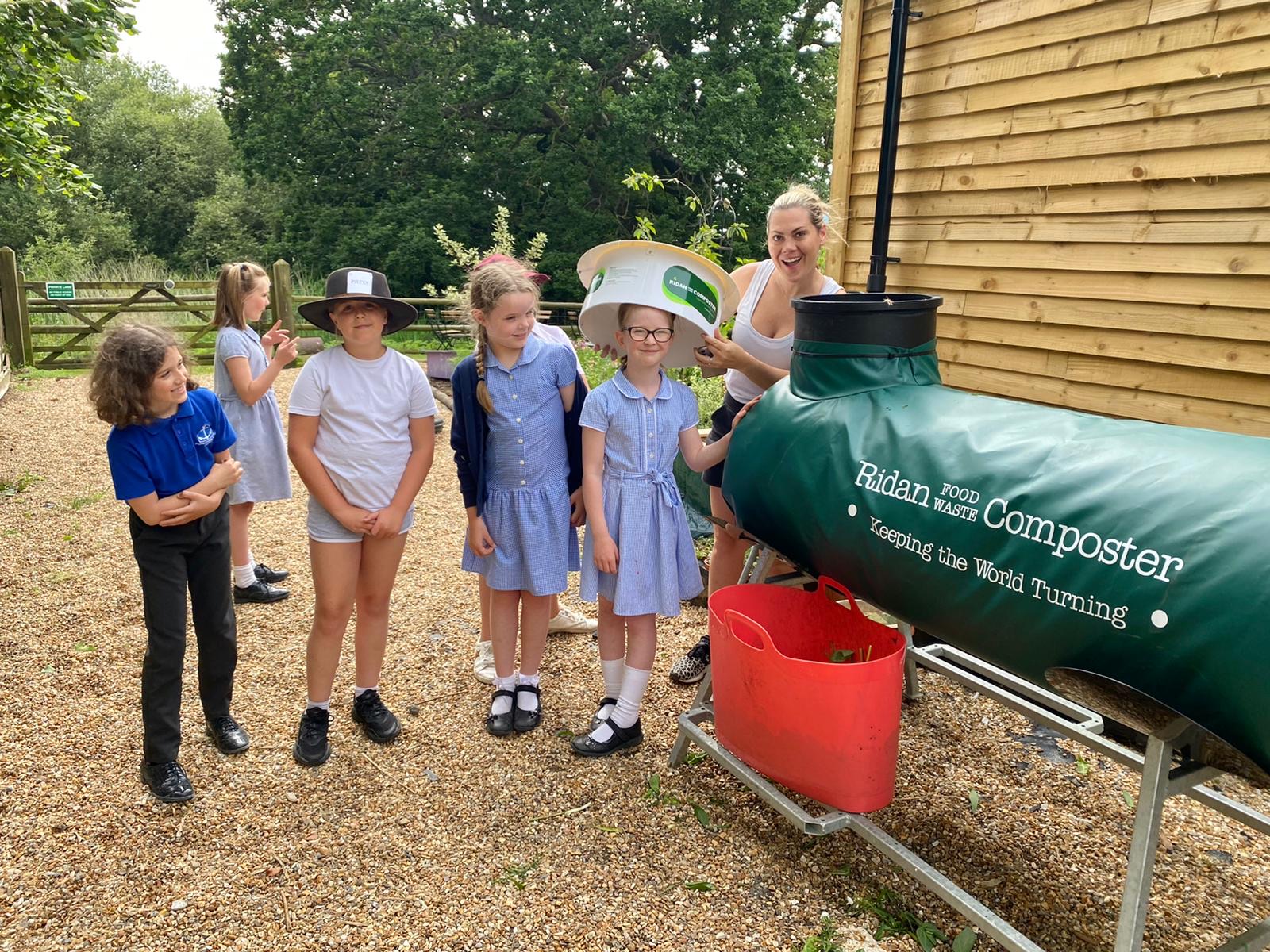
The second composter has been installed to be used by two businesses initially, a floristry business that is also a cafe Blooms & Wishes, and a small hotel Jingles which are on the same site. Again, we will be monitoring the amount of waste that is diverted from general waste streams, and all the compost will be used to grow plants at Blooms & Wishes, with any excess available to the public.
We hope that if these two composters are really successful we will be able to work with more businesses to install more of them, and eventually persuade our local council to consider a public composting service.
We will report back on these later in the year!
The purchase of these composters and the running of this composting pilot scheme has been supported by 11th Hour Racing, huge thanks for helping us to make this happen.